Funding the Gap: What Drives Project Approval on DonorsChoose?
Introduction
DonorsChoose enables teachers across the United States to request funding for classroom projects, ranging from basic supplies to specialized equipment. Although most projects are eventually approved, this high overall approval rate can mask important disparities in which types of projects succeed. This project, titled “Funding the Gap”, addresses a decision-oriented question: which project characteristics are systematically associated with approval, and which types of projects face a higher risk of rejection? Using historical DonorsChoose data, the analysis begins with a correlation-based overview and then examines how approval outcomes vary with project cost, project scale, teacher experience, grade level, and subject category. These factors act as observable signals of deeper constraints such as financial risk, proposal maturity, and donor preferences. The goal is not to evaluate individual teachers, but to identify consistent structural patterns that can inform fairer platform design, stronger onboarding support, and more targeted funding strategies for projects that are currently disadvantaged.
Framing the Question
Decision question: Which project characteristics are most strongly associated with approval on DonorsChoose, and which types of projects are systematically disadvantaged?
Audience: DonorsChoose product, program and policy teams who design submission guidance and funding campaigns.
Purpose and success: The analysis is successful if it identifies structural patterns behind approval outcomes and translates them into actionable recommendations to improve fairness and platform support.
Business Questions
Building on the correlation overview, this analysis addresses the following decision-focused questions:
Which project characteristics show the strongest association with approval outcomes?
Does higher project cost and larger requested quantity jointly reduce the likelihood of approval?
To what extent does teacher experience improve approval outcomes, and under what conditions?
Are certain subject categories systematically advantaged or disadvantaged in the approval process?
Overall Approval Landscape
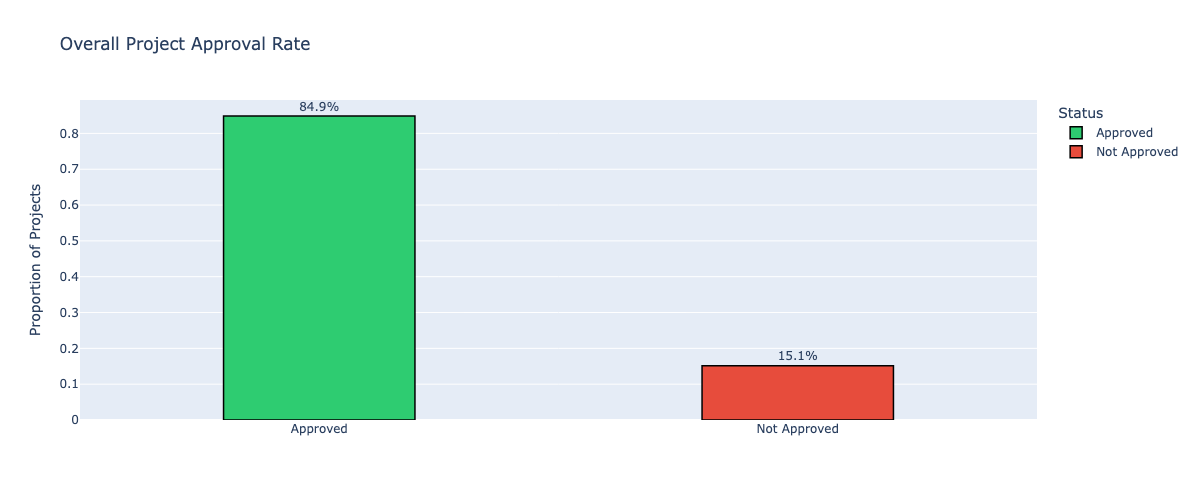
Approximately 85% of projects on DonorsChoose are approved, indicating broad platform accessibility.
Nearly one in seven projects still fails to receive funding.
A single average can hide systematic differences across project types.
This baseline motivates the following correlation-based overview.
What Drives Approval? - A Correlation Overview
This heatmap provides a high-level overview of how key numeric project characteristics
are linearly associated with project approval.
It serves as a diagnostic starting point for the analysis rather than a final explanation.
Key signals from the correlation overview:
Values close to +1 indicate a positive association with approval,
values close to −1 indicate a negative association,
and values close to 0 indicate little or no linear relationship.
Teacher experience exhibits the strongest positive association with approval,
indicating that projects submitted by more experienced teachers are slightly more likely
to be approved.
Project price shows the strongest negative association with approval,
suggesting that higher-cost projects face a greater risk of rejection.
Requested quantity also displays a weak negative relationship with approval,
implying that larger project scope may contribute to lower approval probabilities.
The digit count in the project summary shows a near-zero association,
indicating that simple textual length or numeric content alone does not meaningfully
influence approval outcomes.
Importantly, all correlations are small in magnitude. This indicates that approval decisions
are not driven by any single numeric factor. Instead, these results highlight where the most
relevant signals lie and motivate a deeper examination of how cost, experience and project
scale behave across different ranges and contexts.
The following sections therefore build directly on this overview by first examining
the strongest negative signal—project cost—and then investigating the strongest
positive signal—teacher experience—before exploring how these factors interact.
From Correlation to Trend: Does Project Cost Influence Approval?
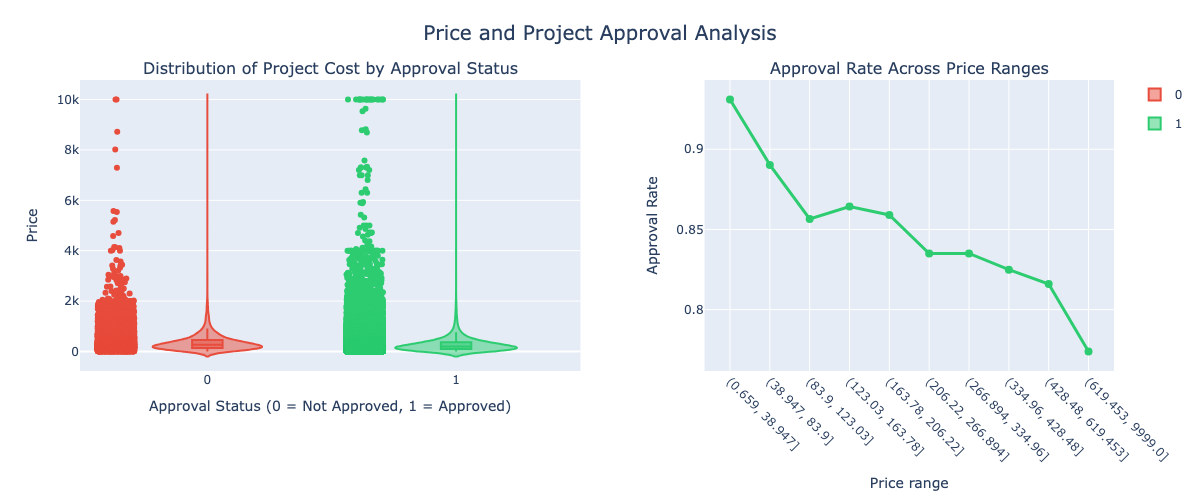
The correlation overview identified project price as the strongest negatively associated numeric feature.
This plot examines how approval rates change across cost levels.
The left panel shows the distribution of project costs for approved and rejected proposals.
The right panel shows approval rates across increasing price ranges.
Approval rates decrease steadily as project cost increases
(from above 90% in the lowest range to around 75–80% in the highest range).
Project cost therefore acts as a consistent constraint on approval, although it does not determine outcomes on its own.
The next section examines whether teacher experience can mitigate this cost disadvantage.
From Correlation to Trend: The Role of Teacher Experience
The correlation overview showed teacher experience as the strongest positively associated numeric feature.
This visualization examines how approval rates change across experience levels.
The x-axis represents teacher experience, measured by the number of previously posted projects.
Approval rates increase with experience, with the largest improvement occurring from first-time
teachers to moderately experienced teachers.
More experienced teachers consistently achieve approval rates above the platform average.
Teacher experience improves approval likelihood, but it does not fully offset the disadvantages associated
with high project cost. The next section examines how cost and experience interact.
Cost and Experience: An Interaction Effect
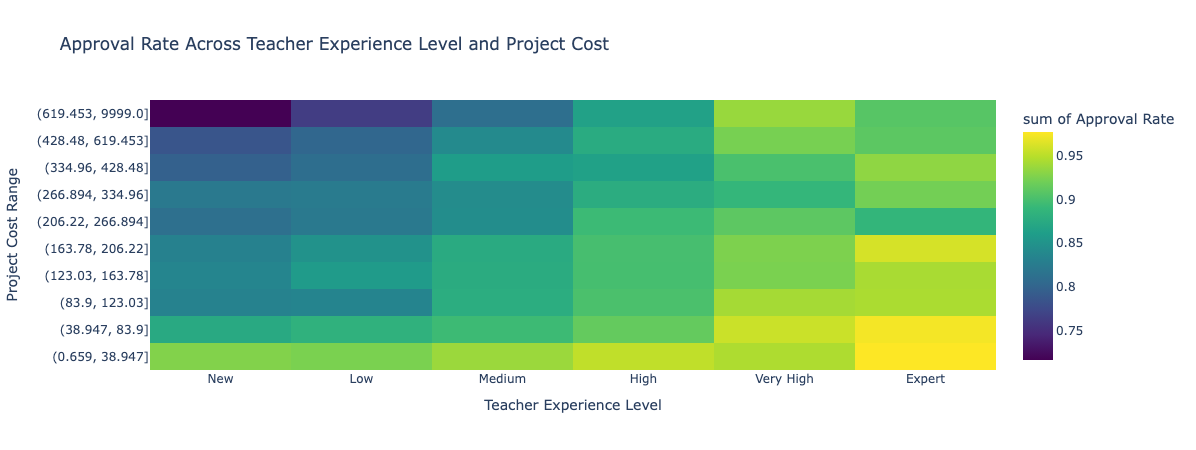
The previous sections showed that project cost is negatively associated with approval and that teacher
experience is positively associated. This heatmap examines how both factors operate jointly.
The horizontal axis shows teacher experience (from new to highly experienced teachers).
The vertical axis shows increasing project cost ranges.
Approval rates are high for low-cost projects across nearly all experience levels.
Approval rates drop sharply for high-cost projects, even for highly experienced teachers.
Teacher experience improves approval likelihood primarily for low- and mid-cost projects.
At high cost levels, project price becomes the dominant constraint.
Project Scale: Quantity and Price Combined
The correlation overview indicated a weak negative association between requested quantity and approval.
This visualization examines how quantity behaves when combined with project cost.
The x-axis shows requested quantity and the y-axis shows total project cost.
Each bubble represents a group of projects; bubble size reflects how many projects fall in that group.
Approval rates are highest for low-quantity, low-cost projects and lowest for projects that are both
high in quantity and high in cost.
Project scale becomes most restrictive when quantity and cost increase together,
indicating that overall project burden—rather than price or quantity alone—drives lower approval probabilities.
Differences Across Subject Categories
The correlation overview focused on numeric project characteristics.
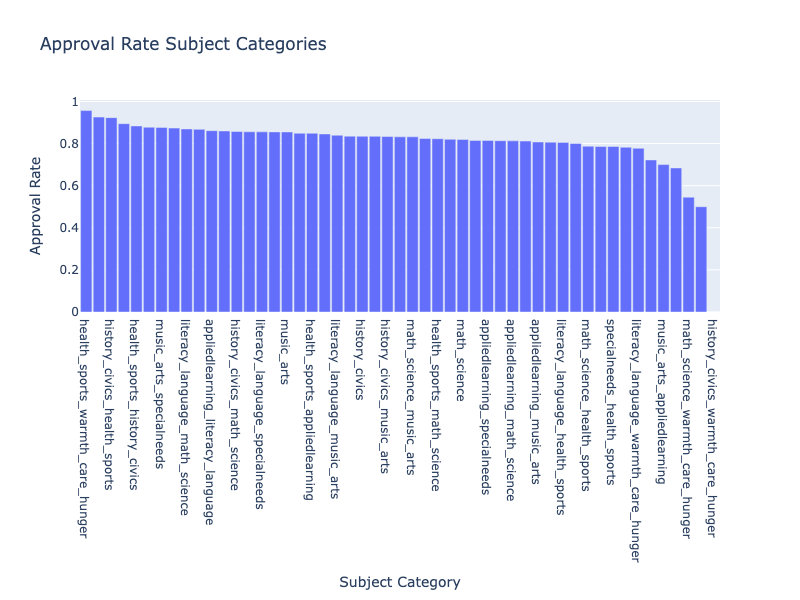
This section extends the analysis to subject categories, which may also shape approval outcomes.
Each bar shows the approval rate for a subject category.
Some subjects consistently achieve approval rates above the platform average,
while others fall noticeably below it.
Core academic and classroom-oriented subjects tend to perform better than
several enrichment or specialized subject areas.
These patterns indicate that approval outcomes are influenced not only by project cost and scale,
but also by donor preferences and perceived instructional priority across subject areas.
Approval Patterns Across Grade Levels
After examining cost, experience, scale and subject differences, this section extends the analysis
to student grade levels.
Each bar shows the approval rate for a grade category.
Projects targeting early and elementary grades achieve the highest approval rates.
Approval rates decline for middle school and high school projects.
These results indicate that projects serving older students face a systematic disadvantage
that cannot be explained by numeric project characteristics alone.
How Cost Impacts Approval Across Grade Levels
Approval rates decline as project cost increases for all grade levels.
However, the strength of this decline varies substantially by student age group,
with projects for older grades experiencing sharper reductions in approval as costs rise.
How to read this plot (with examples):
The x-axis represents increasing project cost ranges,
while each line corresponds to a different grade category.
At lower cost levels, approval rates are relatively high across all grades,
indicating broad support for affordable projects regardless of student age.
As project cost increases, approval rates decline for every grade group,
but the decline is steepest for middle school and high school projects.
For example, a high-cost project for elementary students still maintains a moderate likelihood of approval,
whereas a similarly priced project for high school students falls much closer to the bottom of the chart.
This evidence indicates that projects serving older students are subject to a compounded disadvantage:
they typically require higher budgets and face stricter approval thresholds as costs grow.
Cost therefore amplifies existing grade-related differences in funding success.
Reasons for Project Rejection (Observed Patterns)
High project cost: Projects with larger requested budgets consistently show lower approval
rates across all analyses, making cost the most common risk factor for rejection.
Large project scope: Projects that combine high quantity with high total cost experience
the lowest approval probabilities, indicating that overall project burden increases rejection risk.
Limited teacher experience: First-time and low-experience teachers face higher rejection
rates, particularly when projects are moderately or highly priced.
Grade-level disadvantage: Projects serving middle school and high school students are
more likely to be rejected than those targeting early and elementary grades.
Subject-specific disadvantage: Certain subject categories consistently show lower approval
rates, suggesting that some instructional areas receive weaker funding support.
Recommendations
Provide structured onboarding and proposal guidance for new teachers,
as approval rates are consistently lower for low-experience submissions.
Introduce cost-aware guidance at submission time, such as suggested budget ranges
based on similar successful projects.
Create a dedicated review or campaign pathway for high-cost projects,
which face low approval probabilities regardless of teacher experience.
Increase visibility and targeted campaigns for underperforming subject areas
and projects serving older grade levels.
Monitor approval performance using interaction-based indicators
(for example, high cost × high school × low experience).
Why This Matters
Classroom resources directly affect what teachers can offer their students.
When certain types of projects repeatedly struggle to receive funding,
the result is reduced learning opportunities for specific student groups.
This analysis shows that approval outcomes are driven primarily by structural
project characteristics such as cost, scale, grade level and subject category,
rather than individual teacher effort alone.
Addressing these structural barriers can improve equity in access to classroom
resources while preserving donor choice and platform sustainability.
Conclusion
This project examined which project characteristics are associated with approval outcomes on DonorsChoose.
Although most projects are approved, the analysis reveals persistent and systematic differences across
project cost, scale, grade level, subject category and teacher experience.
A correlation-based overview shows that no single numeric feature strongly explains approval outcomes.
Project cost emerges as the strongest negative signal, while teacher experience is the strongest positive signal.
However, interaction analyses demonstrate that teacher experience cannot fully offset the disadvantages
associated with high project cost or large project scale.
Projects serving older students and several subject categories also experience consistently lower approval rates,
indicating the presence of structural barriers rather than differences in individual proposal quality.
Overall, the findings suggest that DonorsChoose could improve equity and platform effectiveness by introducing
targeted onboarding support, cost-aware project guidance, and dedicated visibility or funding pathways for
high-cost and under-served projects.
References
Singh, B., et al. Donor Retention in Online Crowdfunding Communities:
A Case Study of DonorsChoose.org. arXiv preprint, 2015.
https://arxiv.org/abs/1503.02729